
You don't have to look very far to see that AI is disrupting almost every market it touches.
Depending on the industry, you can see layoffs and hiring sprees happening at the same time. Economic disruption is rarely symmetrical. One industry contracts while another expands, and right now AI is clearly on the expansion side of that equation.
What stands out most to me is the speed.
I remember the digital transition of the late 1990s and early 2000s. Video, storage, editing, distribution, and the internet were all changing, but the transition still took years. Broadband was eventually a huge unlock because it made products practical that simply were not practical before.
AI is moving faster.
And if you think it is moving fast now, wait until the constraints around compute begin to fall. In much the same way bandwidth unlocked the modern internet, more available compute will unlock capabilities that are still difficult to imagine.
Even now, change is happening in weeks and sometimes days. Entire software products can be built in weeks that once required much larger teams and far more time.
What you learned about AI six months ago may already be outdated.
And if your understanding of AI is still mostly that it hallucinates, makes mistakes, or answers questions in a chat window, you may not yet have seen where the technology is headed.
The larger change begins when AI is connected to tools, code, data, workflows, and other systems.
That is where recursive improvement starts to become visible.
When people hear the term recursive improvement, they often imagine an AI rewriting itself and becoming progressively smarter. But a much more practical version is already happening.
AI helps people build better software and better AI tools. Those tools make people more capable. Those people build better tools. Then the cycle repeats.
One reason this is happening so quickly is that AI has started connecting tools that were previously disconnected by layers of specialized knowledge. Programming languages, databases, APIs, cloud systems, frameworks, testing tools: they all existed already. AI is making it much easier to move between them and connect them.
In that sense, AI is becoming a kind of glue.
That matters because once the tools become easier to use together, engineering capacity increases.
And when engineering capacity increases, the engineers do not disappear.
Their attention moves somewhere else.
We have seen versions of this before.
MP3 and digital distribution changed music by giving millions of creators access to distribution that had once largely belonged to major labels.
Digital video did something similar.
I remember installing professional editing systems that cost about as much as a new car, took weeks to configure, and consumed an entire room.
Today, you carry more capability in your pocket.
The important change was not simply that professional editors became more efficient. The barrier to participation collapsed.
AI is doing that to software now.
But I don't think software is where this ends.
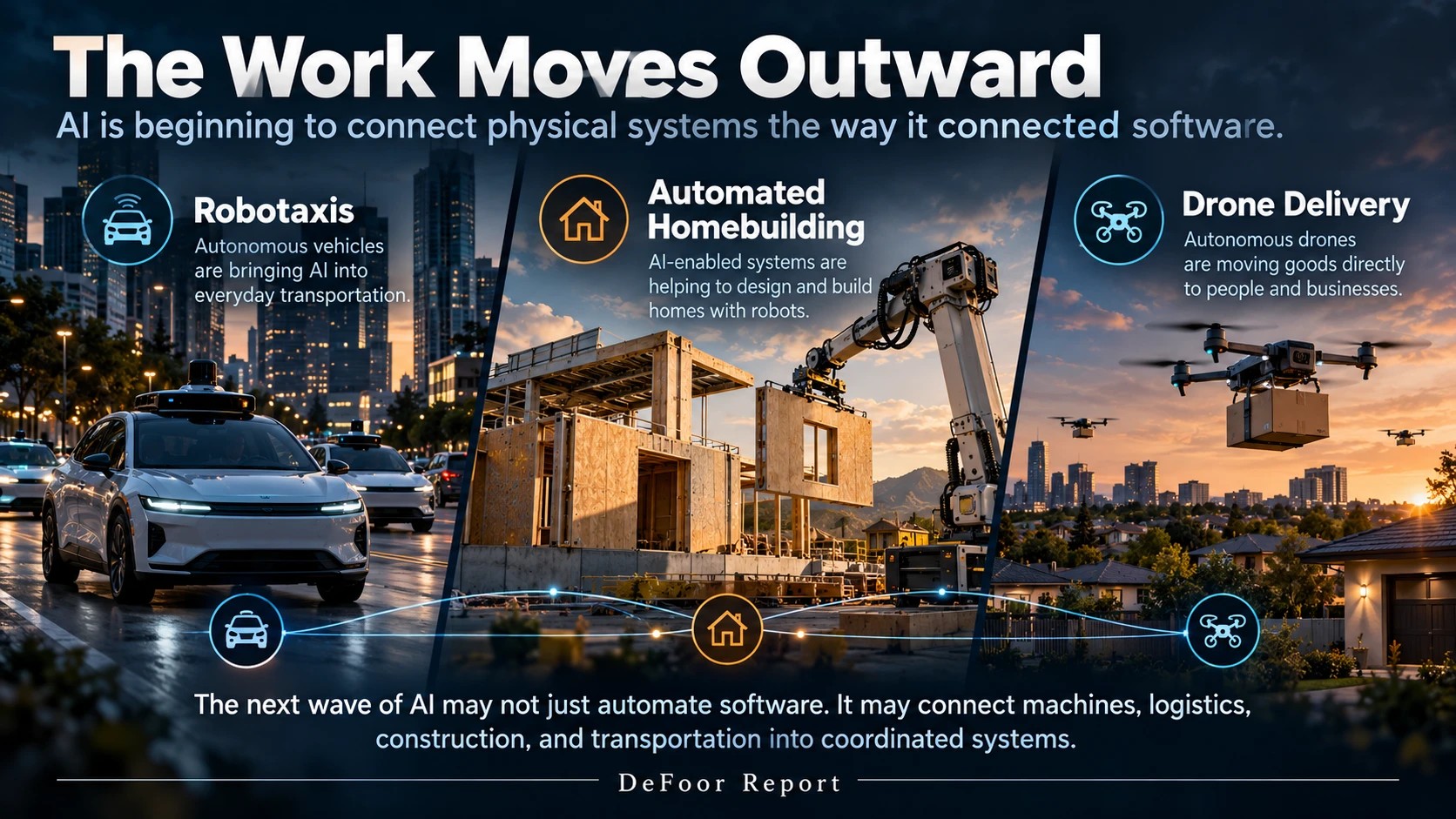
Look at the physical world and you can already see many of the pieces.
CNC machines. Robotics. Additive manufacturing. Autonomous vehicles and delivery systems.
These technologies already exist, but much of the automation still operates in silos. Different machines, different software, different control systems, and different specialists are often needed just to make everything work together.
That looks a lot like software did before AI began tying its tools together.
The next major shift may be AI doing the same thing in the physical world.
A machine sees what is happening. Another system decides what should happen next. A robot performs an action. Manufacturing equipment produces the part. Software coordinates the process.
The tools are already here.
The missing piece is often the connection between them.
This is why I think the idea that some industries are "protected" from AI may be looking at the problem from the wrong angle.
The question is not simply whether AI can perform today's job exactly the way a person does it now.
Technology often does not improve the old process by 5 or 10 percent.
It changes the process.
The automobile did not make the horse faster.
It changed transportation.
The same thing can happen when AI meets physical automation.
And now there is another force pushing this forward: software engineering itself is becoming more productive.
If a team can accomplish in weeks what once took months, engineering effort is freed to work on other problems.
Those people do not stop building.
They move outward.
They take more capable tools with them and begin working on problems that were previously too expensive, too specialized, or simply not economical to solve.
That is the ripple effect I think is easy to underestimate.
AI reduces the labor required to solve one class of problems. That capability moves to another class of problems. AI helps connect tools that were previously separate. More problems become economical to solve. Those solutions create more capability, and the cycle continues.
Software is feeling this first because it was the easiest environment for AI to enter.
But software is not where this ends.
It is where much of the leverage is being created.
The physical world is full of machines, sensors, robots, automation systems, and specialized tools waiting for the same kind of connective layer AI is now providing to software.
So I think "Which jobs will AI replace?" is probably too narrow a question.
The more interesting question is what happens when AI connects the tools we already have while also freeing capable people to work on problems that were never economical to solve before.
That is where the next phase begins.
The work does not disappear.
It moves outward.