
AI gate
An AI model reads what earlier gates produced and writes this gate's evidence: a summary, a decision, extracted data, a draft.
Home / Products / Process Runner
 Process Runner™
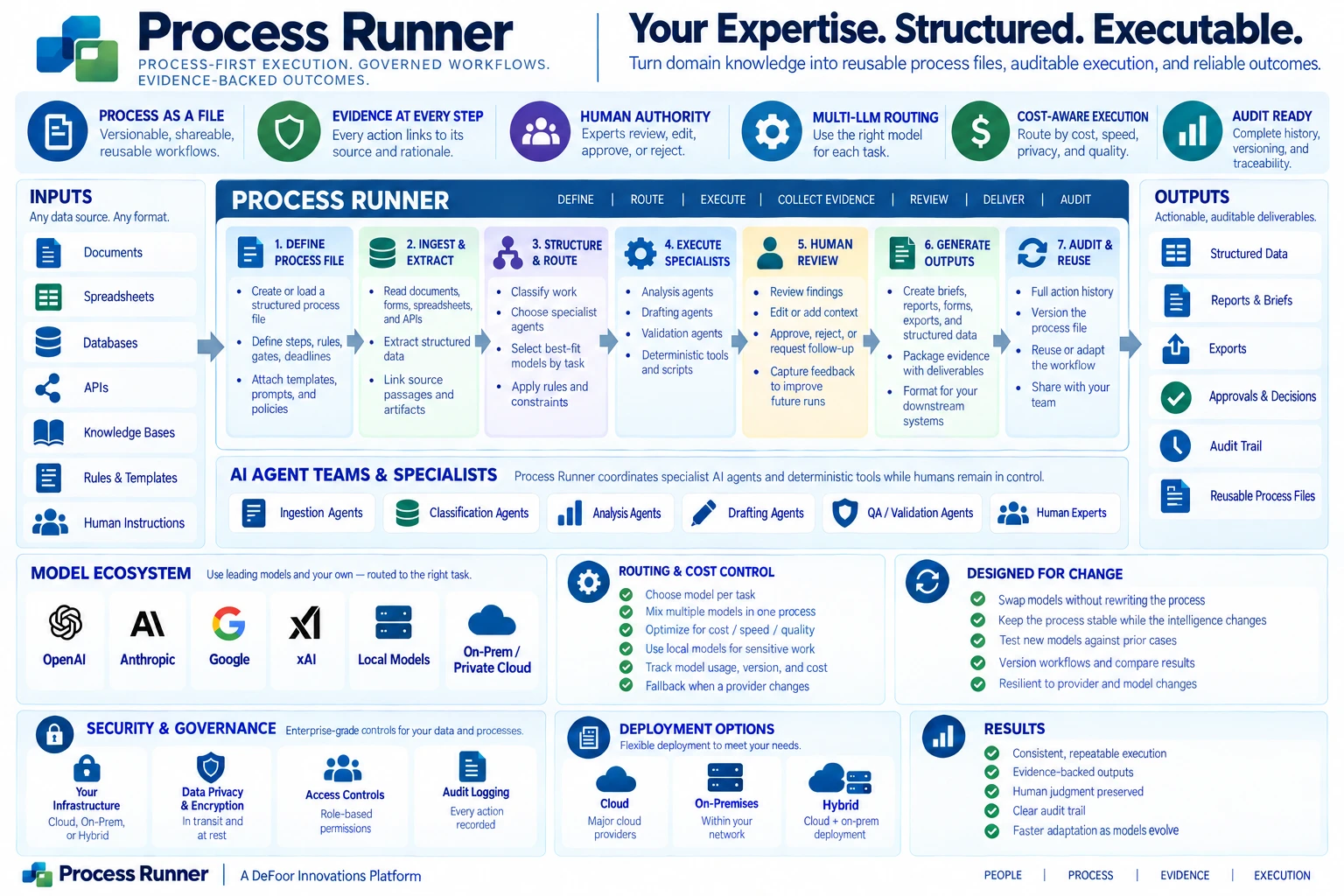
Process Runner turns a workflow into a process file: a list of steps for AI, for people and for other systems. Each step finishes only when its evidence is in, and every run keeps a record of who did what, with which AI, at what cost.
The idea
Most work already follows a process, but it lives in people's heads, in email threads and in whichever chat window was open that day. Process Runner writes it down as a file: the steps, who or what does each one, what each step has to produce, and what happens next.
The file is portable and versioned, so a process runs the same way for one person or a whole team, and it gets better as you change it. You build it in plain language.
How it works
List the steps, the roles, what each step must produce and what happens next. A step in Process Runner is called a gate.
An AI model, a person, a prebuilt agent or another whole process does the work of a gate. Some gates run side by side.
A gate completes only when what it must produce is in: an answer, a file, a signature, an approval. Then the gates that depend on it unlock.
Who did what and when, which AI model, how many tokens and what it cost, and every approval. Memory carries what was learned into the next run.
The building blocks
An AI model reads what earlier gates produced and writes this gate's evidence: a summary, a decision, extracted data, a draft.
Waits for the right signed-in person to answer, approve or sign. Nothing that needs a person is completed by an AI.
A prebuilt agent does a known job: reads a PDF, searches the web, buys a domain, sends the result where it belongs.
Runs another whole process as one step, so a good process can be reused inside a bigger one.
Runs several pieces of work at the same time and waits for all of them before the process moves on.
Examples
Before planning anything, AI models from four vendors each look at an idea from a different angle, one after another, and a person decides what goes forward.
Result: a ranked slate of ideas from several vendors, and the person's pick, on record.
A customer asks a store's Relay helper for a refund. Two AIs from different vendors check it, the customer's account age and history count too, and a person decides only the close calls. The same process can open a new account.
Result: clear refunds go through on their own, close calls go to a person with the reasons in hand, and every score and decision is on record.
An estimator's door takeoff, read from the drawings and the specifications instead of typed in by hand.
Result: the takeoff in the estimator's own spreadsheet layout, with every flagged line signed off.
An outside AI agent buys something from a site, inside the site's rules, and both sides keep a receipt.
Result: paid, on the site's terms, with a receipt either side can check. More about Agent Payments
Inside a process
This is the refund example above. Each gate says who does it, what it must produce and what it waits on. Two AIs from different vendors score the request separately, so no single model decides alone. When both score 90% or higher, the account is at least 6 months old and the customer's history score is 80 or higher, the refund goes through. When any one falls short, it waits for a signed-in person who sees the scores and every reason.
Change the threshold or the policy and the next run follows it. Every run records the version it ran.
# Refund: two AIs check it, a person takes the close calls

gate 1    The request
  done by       Relay, the helper
  must produce  the order, the amount and the reason
                the customer's account age and history score
                the conversation, private details taken out
  waits on      the customer's request

gate 2    The check, both AIs at once
  done by       two AIs from different vendors, separately
  must produce  each one's score against the refund policy
                each one's reasons
  waits on      gate 1

gate 3a   The refund
  runs when     both AI scores are 90% or higher
                the account is at least 6 months old
                the history score is 80 or higher
  done by       the payments agent
  must produce  the refund receipt

gate 3b   The decision
  runs when     any one of those falls short
  done by       a person on the team, signed in
  sees          every score and every reason
  must produce  approve or decline, and why

gate 4    The answer
  done by       Relay
  must produce  the outcome, told to the customer
  waits on      gate 3a or gate 3b

# On record: every gate, score, reason and decision,
# and the version of the process that ran.
Any AI model
Models change. The process stays the same.
Run a whole process on one model, or give every step its own: a five-step process can use five different models. Process Runner works with the major vendors and the rest, including models running on your own machines. You choose which ones are allowed.
Pin a model to a step, or let the router start with the cheapest model that can do the job and move up when it can't. If a vendor is down or out of credit, the step moves to another. Every call's model, tokens and cost go into the run record. Read why.
Cost your processes
Every run records each AI call: the model, the tokens in and out, and what it cost, with a running total for the run. Add it up per step, per run or per process, so you know what a process costs before you sell it or scale it.
| Step | Model | Tokens | Cost |
|---|---|---|---|
| Load past learnings | Gemini Flash-Lite | 6,120 | $0.001 |
| Lens 1: capability | Claude | 11,840 | $0.092 |
| Lens 2: experience | GPT | 12,310 | $0.064 |
| Lens 3: integration | Gemini | 13,020 | $0.041 |
| Lens 4: new uses | Grok | 13,550 | $0.058 |
| 6 more AI steps | mixed | 61,900 | $0.154 |
| Total | 4 vendors | 118,740 | $0.41 |
People stay in charge
A human gate checks who is signed in, not a name someone typed. The person who asks for something is not the one who approves it.
A step that fails is tried again, and a step that keeps failing is flagged to a person instead of being dropped.
Each run keeps a ledger whose entries are hashed and chained, so an edited, deleted or reordered entry shows.
What a run learns is saved with where it came from and how long it holds, and the next run starts with it.
Choose which AI vendors may process your data. If a step fails over, it never lands on a vendor you ruled out.
A process can be exported as a signed package and imported elsewhere, and its version travels with every run.
Built on Process Runner
Put your process on Process Runner
Basic to enterprise pricing available.
 Relay
 DeFoor Report
 Door Takeoff